
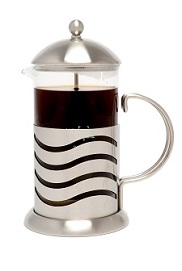
A French press is a glass pot with a metal filter in which coarsely ground coffee and hot (just below boiling) water are combined.
The coffee brews for about four minutes, after which the metal filter is slowly pressed down through the pot. The tightly fitting filter pushes the coffee grounds to the bottom. The result is fresh, hot coffee ready to be poured directly.
Because a metal filter is used, certain natural oils and aromatic compounds remain in the coffee. A disadvantage is that some of these substances, such as cafestol, can increase cholesterol levels. This effect generally only applies when consuming four to five cups of French press coffee daily.
Those who wish to avoid these compounds are better off choosing paper-filtered coffee, as substances such as cafestol remain behind in the paper filter.
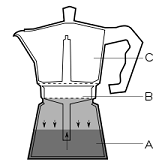
Water boils, passes through finely ground coffee, and is collected in the upper chamber.
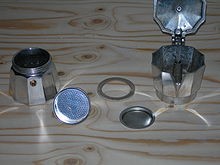
The parts of the Moka Express
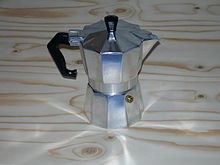
The Moka Express, or simply Moka, was invented by Italian Alfonso Bialetti in 1933. He was inspired by a washing machine that forced hot water upward through detergent under pressure. He designed the iconic octagonal aluminum coffee maker, now found in almost every Italian household.
Coffee brewed with a Moka is not technically espresso, as the pressure is much lower—around 1.5 bar instead of 9 bar. As a result, it lacks the typical crema layer. The grind used is often not as fine as espresso grind, but closer to standard coffee grind.
Originally made from aluminum, Moka pots are now available in stainless steel, partially plastic, or porcelain. Sizes range from single-cup to family-sized models, and electric versions are also available. Prices typically range from €15 to €70.
A related device is the Atomic coffee maker, created in 1946 by Italian industrial designer Giordano Robbiati. It operates on a similar principle but includes a steam wand for frothing milk.
How it works
The Moka Express consists of five main parts: the water reservoir, the coffee filter basket, a rubber gasket, an upper metal filter, and the collection chamber.
As the water heats up, pressure builds and forces hot water through the coffee grounds into the upper chamber. Newer models include a safety valve to release excess pressure.
Usage tips
When using a new Moka pot, the coffee may initially taste metallic. Over time, a natural protective layer forms inside the aluminum. For this reason, it is recommended to clean the Moka with hot water only—avoid detergents.
Moka coffee can taste slightly bitter. This can be reduced by filling the reservoir with pre-boiled water, shortening the brewing time.
The ideal grind size is between espresso and drip coffee. A grind that is too fine may pass through the filter.
Turn off the heat as soon as you hear the typical bubbling sound, indicating that brewing is complete. Allowing the coffee to boil may damage the pot.